

How the Design-Build Process Prevents Budget Overruns
A Guide for Homeowners in Danbury, Fairfield County, and the Surrounding Area

Ask any Fairfield County homeowner why they hesitate to remodel, and the answer is rarely about the dust or the noise. It is the fear of the “Money Pit.” Most people know the cautionary tales of renovations that began with a reasonable estimate but ended with a final bill 30% higher than expected.
At Kitchen Traditions, the team believes that going over budget should not be a normal part of construction. It is usually the result of a broken process.
For over 20 years, Kitchen Traditions has served Danbury, Bethel, and Newtown with a refined approach. By utilizing a Design-Build process, the firm eliminates the communication gaps in traditional construction that lead to spiraling costs. This commitment to fiscal responsibility and quality has contributed to the firm’s recognition, including a HOBI Award for Best Residential Remodel in Danbury.
Here is a simple look at why renovations often go over budget, and exactly how the Kitchen Traditions process protects the homeowner’s investment.
The Flaw in the “Old Way” of Building
To understand why budgets fail, it is helpful to look at how the industry has traditionally operated. In the standard model (known as “Design-Bid-Build“), a homeowner hires an architect to draw plans, then sends those plans to different contractors to get price quotes.
This separation creates a financial gap. The person drawing the plans is often disconnected from the current cost of materials. An architect might design a custom range hood, unaware that the price of the necessary vent parts has doubled in the last six months. When the contractor finally gives a price for that design, it shocks the homeowner.
Furthermore, if a contractor finds a problem on-site—such as a pipe blocking a beam—work stops. The contractor blames the drawings; the designer blames the builder. While they argue, the homeowner pays for the “Change Order” (an unexpected bill added to the contract). Kitchen Traditions operates differently.
The Solution: One Team, One Responsibility
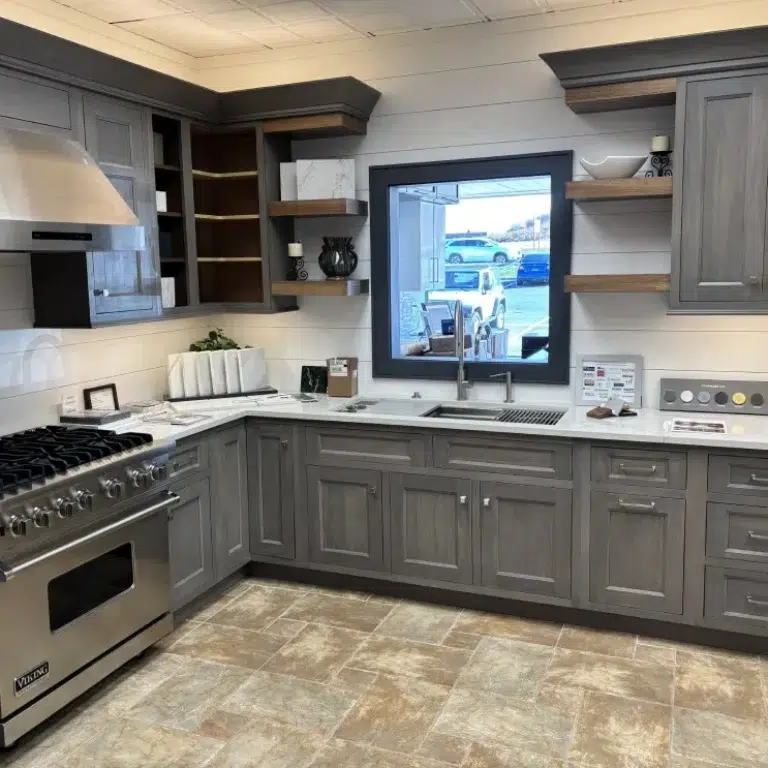
Kitchen Traditions operates as a Design-Build firm. This means a single team manages the entire project, from the first floor plan to the final cabinet installation. Because the firm handles both the design and the construction contract, responsibility is centralized. If the design team proposes a kitchen island with a prep sink, they immediately check the cost of cutting into the concrete floor to add the plumbing. The firm does not design concepts that cannot be built within the agreed budget. This teamwork creates a shield against the “surprise costs” that plague projects where the builder and designer don’t talk to each other.
Four Ways We Keep Costs Down
The firm relies on four specific rules to keep budgets on track.
1. The “Materials-First” Rule (No-Start Policy)
Price changes and shipping delays are major causes of budget problems. In a typical project, a contractor might tear out a kitchen on Monday and order cabinets on Tuesday, only to find they are backordered for 12 weeks. During this delay, prices for other materials may rise, and the homeowner is left without a kitchen.
- Kitchen Traditions prevents this with a specific policy: Construction does not begin until the cabinet order has arrived.
This protects the client in two ways:- Locked-In Prices: Ordering materials immediately upon signing the contract secures the cost against future price hikes.
- Efficiency: Once work begins, the timeline moves forward without interruption. Homeowners avoid the costs and stress of a job site sitting empty.
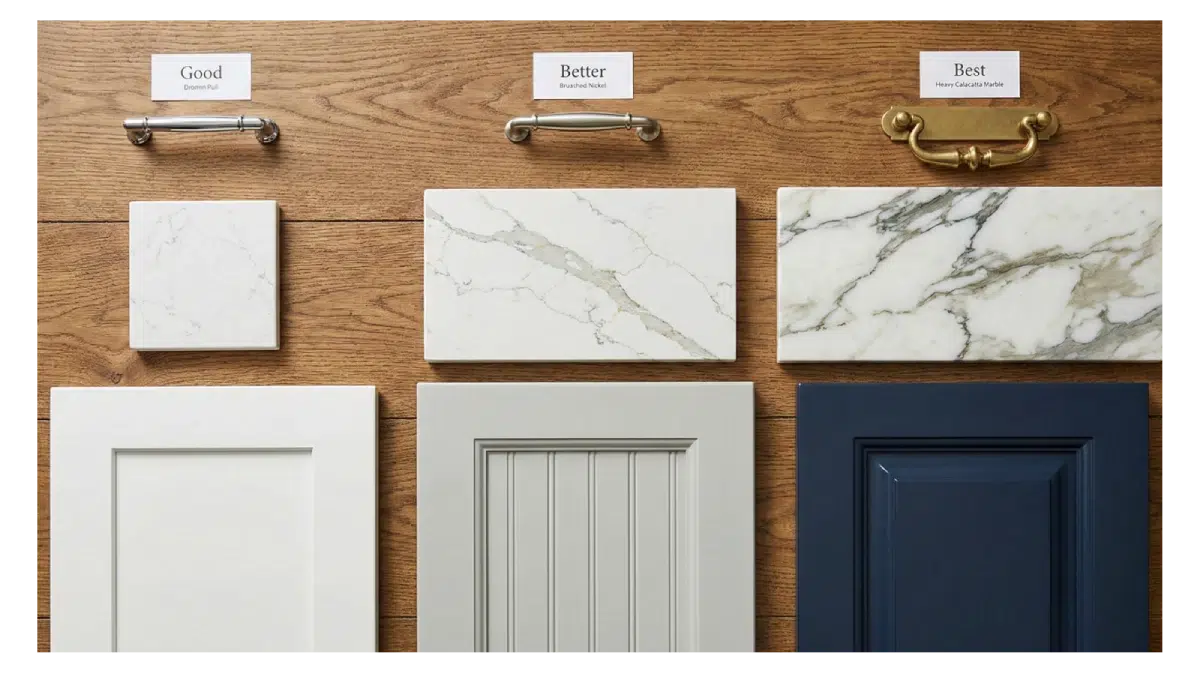
2. Real-Time “Good-Better-Best” Pricing
In many home renovations, budgets break during the selection phase. A homeowner might have a set limit but fall in love with expensive finishes without realizing the total cost until it is too late. Kitchen Traditions combats this with a “Good-Better-Best” pricing structure. During the design phase, the client sees concrete options at different price points. The team might present a stock cabinet line (Good), a semi-custom line (Better), and a fully custom line (Best). The client sees exactly how each choice changes the final price before finalizing the plan. This transparency allows the homeowner to spend money wisely—perhaps choosing “Best” countertops while selecting “Better” cabinetry to stay on target.
3. The Virtual Build: 3D Visualization
Unexpected costs frequently happen because a homeowner sees a framed wall and realizes, “I didn’t think it would look like that.” Moving a wall on paper is free; moving it after it is built is expensive. The design team uses 3D imagery and in-person showroom meetings to model the kitchen virtually before construction begins. This process checks the design and identifies layout problems—like a refrigerator door swinging into a walkway—while still on the computer. Solving these issues digitally prevents costly re-work on the job site.
4. Local Expertise in Danbury
Renovating in Fairfield County requires specific knowledge of local codes and older homes. Generic estimates often fail to account for these local details.
- The Historic Factor: Kitchen Traditions has extensive experience working within Danbury’s historic neighborhoods, such as Deer Hill Avenue and Main Street. Older homes often hide knob-and-tube wiring, old framing styles, or uneven floors. A low-bid contractor might treat these as “surprise” extra costs. Kitchen Traditions anticipates these conditions based on 20+ years of local experience, building safety nets into the initial budget so the “unknowns” are covered.
- Permitting Precision: Danbury’s permit fees are calculated based on construction value. Inaccurate numbers on permit applications can lead to delays or fee adjustments. The firm handles all permit applications—including electrical, plumbing, and mechanical—ensuring compliance with city rules and preventing paperwork delays.
The “While You’re At It” Trap
Even with a perfect plan, budgets can fail due to “Scope Creep”—the temptation to add “just one more thing” once the walls are open. Kitchen Traditions welcomes expanded projects but handles them with financial discipline. Because the initial proposal is detailed—listing specific fixtures, finishes, and labor—any addition is treated as a separate, clear decision. The client receives a fixed price for the addition before work proceeds, ensuring there are no surprise bills at the end of the project.
Danbury Kitchen Renovation FAQ
Q.1. Is Design-Build cheaper than hiring a separate architect and contractor?
A.1. Often, Design-Build is more cost-effective in the end. While a general contractor might offer a cheaper initial estimate, the Design-Build kitchen remodel process typically results in lower total costs because it significantly reduces change orders and design errors.
Q.2. How accurate are Kitchen Traditions’ estimates?
A.2. Because the firm acts as both the material supplier and the contractor, estimates are based on real-time catalog pricing rather than guesses. Once the “Good-Better-Best” selection process is complete, the proposal price is fixed, barring major structural discoveries.
Q.3. Does a kitchen remodel in Danbury require a permit?
A.3. Yes. Kitchen remodels involving plumbing, electrical, or mechanical work require permits from the City of Danbury Building Department. Kitchen Traditions manages this process (License # HIC.0653775).
Q.4. Can homeowners buy their own materials?
A.4. The firm generally advises against this. When Kitchen Traditions sources materials, they take responsibility for shipping damage and warranty issues. If a homeowner buys their own materials, they are responsible for storage, checking for damage, and handling returns, which can delay the project schedule.
Predictability is a Luxury Homeowners Deserve
A kitchen renovation is a significant investment. Homeowners deserve to know exactly where that money is going.
At Kitchen Traditions, the team views themselves as partners in protecting the client’s budget. The Design-Build process is designed to strip away financial anxiety, leaving the client with the fun part: watching their dream kitchen come to life.
Ready to discuss a project with a firm that respects your budget?
Contact us today to schedule your Complimentary In-Home Design Consultation. We will come to your home, take measurements, and help you understand what is possible within your budget.

